
Sound Graffiti
Sound Graffiti are sound installations created with self-contained sound modules.
These are small devices placed in public space that play audio, introducing temporary artistic interventions into the urban fabric.
Key features of Sound Graffiti:
- Interactivity – a sensor triggers the module when a passerby approaches,
- Discreetness – installed unobtrusively, often out of sight,
- Temporariness – they last as long as the battery allows, or until they remain untouched in the space.
The public can discover them by chance while passing by, or deliberately using a QR code and the map on the web platform.
SoundGraffiti Platform
The SoundGraffiti platform is conceived as a meeting point between artists and the public through sound in public space.
Launched in 2016, it has been continuously mapping and archiving sound installations in urban environments ever since.
It enables authors to present, document, and place their works on a map, while giving citizens a way to explore, discover, and experience them in different ways.
Each work on the platform has its own page with information on:
- the title and description of the work,
- the year of realization,
- the author and their biography,
- photo, audio, and video documentation,
- and a QR code linking the work to its location on the map.
In this way, the platform functions both as an archive and as a living network: works remain permanently documented and available online, while at the same time they continue to live in the city.
Access to the SoundGraffiti platform is possible in two ways:
- On site — by scanning the QR code placed on the sound module,
- Online — by entering the web address www.SoundGraffiti.org.
Thus, the works exist in two forms: in the real city space, where passersby encounter them in motion, and on the internet, where they can be explored and compared via an interactive map and archive.
Participants
SoundGraffiti is an open platform involving both creators and the public.
Authors & artists
- can submit their works via the Work Submission form,
- after approval, each work receives its own page, a QR code, and a place on the map,
- use the platform to document their projects and share them with the audience.
Audience – citizens & tourists
- can stumble upon works by passing a sound module in the city,
- can scan the QR code to instantly learn more about the piece and the author,
- or explore everything online via the interactive map.
In this way a two-way relationship is created: artists gain a space to present and archive their works, while the public gets simple, engaging ways to discover and experience them.
Sound Module
A sound module is a small, self-contained device that enables SoundGraffiti to be performed anywhere in public space.
It is equipped with a motion sensor that activates when someone approaches within about three meters and plays the audio prepared by the author.
Key features of the sound modules
- resistant to weather conditions,
- dimensions depend on the design (on average about 12 × 8 × 2 cm),
- recordings are played in MP3 format,
- playback duration depends on the author’s concept and the built-in memory,
- module autonomy depends on the battery capacity.
Installation in space
When installing, care must be taken not to damage the surface to which the module is attached. The most commonly used method is polyurethane foam.
Submit Work
Artists who wish to participate can submit their works via the online Work Submission form.
The form lets you enter all required details:
- basic information about the work (title, year of performance, description)
- audio, photo, and video documentation
- author information and a short biography
- the work’s location on the map (address, city, coordinates)
After submission, the work is reviewed by an administrator and then published on the platform. Each approved work receives:
- its own page on the platform
- a QR code linked to its location
- a place on the interactive map
This way, authors gain visibility and an archive of their works, while the audience gets access to new sound interventions in public space.
For additional questions or information, contact us at: soundgraffiti.info@gmail.com
History of the SoundGraffiti platform
The SoundGraffiti (Sound Graffiti) platform was launched in 2016 as a continuation of artist Nenad Laktašić’s long-term work with sound installations in public space (Sound Graffiti), begun in 2013 with the piece Cvrčci (Cicadas) at the Museum of Contemporary Art in Zagreb (MSU), winter 2013. Media coverage of the work: tportal – “The MSU building will breathe to the sound of cikadas” (2013).
From the start, the platform has systematically mapped and archived works, and over the years has evolved in visual identity and functionality, following the development of the practice and the needs of authors and audiences.
Archival snapshots
Old homepage image (2016-2019)
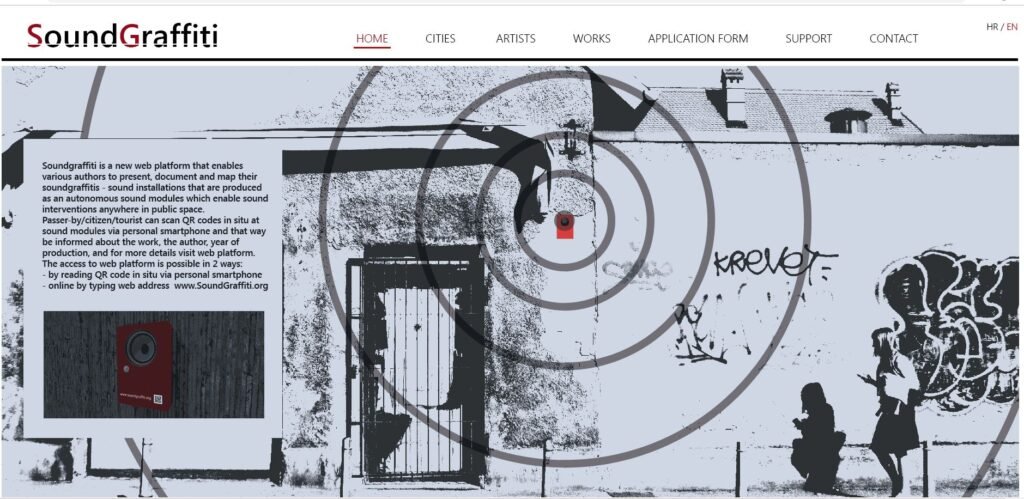
Co-funding
- City of Zagreb — the Sound Graffiti programme has been co-funded since February 2019, based on the Public Call for Cultural Programmes of the City of Zagreb for 2019 (application submitted in October 2018).
Public needs in culture of the City of Zagreb 2019 – Innovative Artistic and Cultural Practices (PDF) - Ministry of Culture and Media of the Republic of Croatia — co-funding platorm Sound Graffiti since February 2020, through the programme Innovative Artistic and Cultural Practices (application submitted in October 2019).